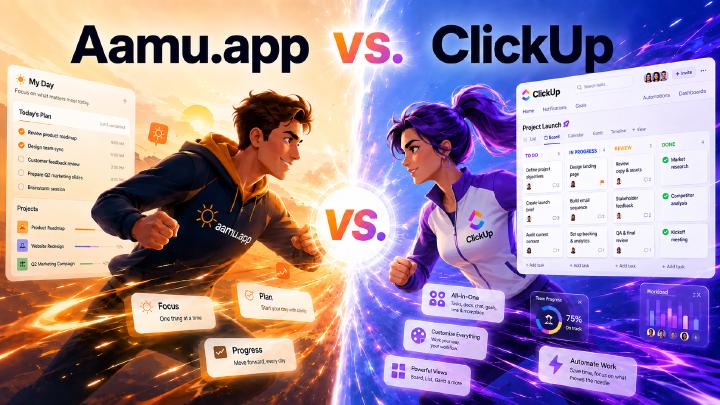
Short answer: Aamu.app is a ClickUp alternative for teams that want project work connected to customer conversations, email, meetings, databases, and permission-aware shared knowledge in one workspace.
ClickUp combines tasks, Docs, Chat, dashboards, automations, time tracking and AI in a work-management platform.
Aamu combines project work with Helpdesk, Livechat, email, meetings, Databases and knowledge retrieval. Compare the full workflow you need rather than assuming either product stops at task management.
ClickUp is a work-management everything app
ClickUp’s feature overview covers task hierarchies, views, Docs, dashboards, automations, time tracking, templates and reporting. Check the relevant plan when comparing these with your requirements.
ClickUp also connects conversations and documents to tasks. A message can become a task, and a task can remain connected to the Docs and discussions around it. That is important because a task should carry more than a title, an assignee, and a due date.
Aamu starts with the work around the work
Aamu Tasks are also meant to make ownership and follow-up clear. The difference is that a task can be created from the wider flow of the workspace: a Helpdesk conversation, a meeting, an email, a database record, or a project discussion.
That matters for small teams because the person doing the work is often also the person answering the customer, writing the documentation, and making the decision. The internal task and the external context are not separate departments. They are two views of the same piece of work.
In Aamu, the surrounding objects can stay close:
Helpdesk keeps the customer conversation and internal follow-up together.
Docs can explain a process, product decision, or support answer.
Meetings and transcripts can lead directly to tasks and decisions.
Emails can remain part of the project context instead of becoming an isolated inbox thread.
Databases can hold the structured records that tasks operate on.
Team Brain and Company Brain can make relevant workspace knowledge available to AI-assisted work.
The key comparison: project context or company context?
ClickUp's strength is making project and team execution visible. It gives a team a rich system for organising tasks, workflows, views, and reporting.
Aamu's emphasis is the connection between execution and the company context behind it. A task to “fix the onboarding instructions” may have started as a customer question. The useful context can include the original Helpdesk ticket, a meeting where the issue was discussed, the current Doc, and a database record for the customer or feature.
From a customer question to completed work
Consider a customer asking whether a particular integration supports a specific setup.
The question arrives in Aamu Helpdesk or Livechat.
Aamu can retrieve relevant Docs and shared knowledge for the support person or an AI draft.
The human reviews the answer and sends it, or turns the missing information into a new Doc.
If product work is needed, the conversation becomes a Task with the original context still nearby.
A meeting can produce the decision and the implementation follow-up without losing the customer reason behind it.
The improved Doc can help answer the next similar question.
Both products can connect internal work to other context. Test the complete support-to-delivery workflow, including where customer replies, documentation updates and follow-up tasks are handled.
AI is only as useful as the context it can reach
ClickUp includes ClickUp Brain and AI features across tasks, Docs, conversations, and other workspace areas. That makes AI part of the work-management environment rather than a separate chatbot.
Aamu takes a similar approach to contextual AI, with an additional focus on support and company knowledge. Team Brain and Company Brain can help retrieve information from the workspace, while Helpdesk and email workflows can use that context to prepare replies for human review.
ClickUp also offers Connected Search across supported external sources and email in tasks. Aamu’s comparison here focuses on its project-based Helpdesk and maintained support knowledge.
When ClickUp may be the better choice
ClickUp may be the better choice when project and work management are the central requirements. Choose it when the team needs deep task configuration, a broad selection of project views, detailed dashboards, extensive templates, or a mature hierarchy for organising complex work.
It is also a sensible choice when the team already has customer support and email systems that work well and only wants to improve the internal execution layer. In that situation, ClickUp can be the focused centre for projects and tasks.
When Aamu may be the better choice
Aamu is a strong fit when the team wants to reduce the distance between the customer, the company knowledge, and the person doing the follow-up. It is especially relevant when:
support questions frequently become product or operations tasks,
Docs need to stay close to the work that keeps them accurate,
meetings and email create real project follow-up,
structured data and everyday tasks belong to the same project, or
AI should work from permission-aware company context and keep a person in control of customer replies.
Related articles
Aamu.app vs Asana: tasks are better when they remember why they exist
Aamu.app as an AI workspace alternative to Notion AI, Slack AI, Jira, and Zendesk
Frequently asked questions
Is Aamu.app a ClickUp alternative?
Yes. Aamu.app is an alternative for teams that want tasks and docs connected to customer work, email, meetings, databases, and shared knowledge.
How is Aamu.app different from ClickUp?
Aamu includes project-based Helpdesk and Livechat alongside Tasks, Docs, email, meetings and Databases. ClickUp also supports email and connected search; compare the specific support workflow and integrations you need.
When is ClickUp the better choice?
ClickUp may be the better choice when advanced project-management views, hierarchy, dashboards, templates, and work-management depth are the team's main requirements.