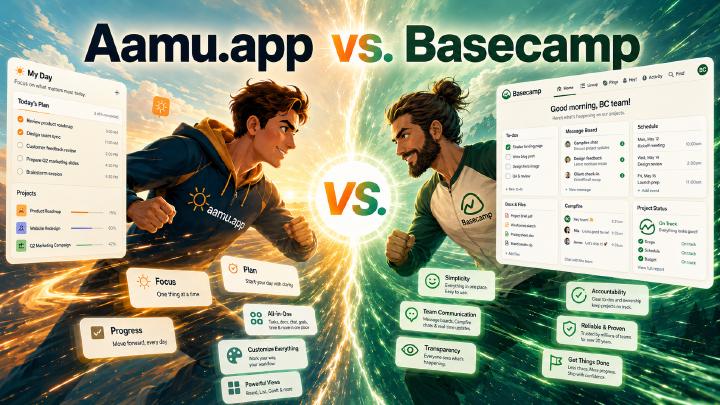
Short answer: Aamu.app is a Basecamp alternative for teams that want the calm, project-based organization of a shared workspace together with Helpdesk, email, meetings, databases, and permission-aware company knowledge.
Basecamp has always asked a useful question: can a team keep project work in one calm, understandable place? Its project page brings together discussions, to-dos, schedules, files, chat, and other tools that help a group move work forward.
Aamu also organizes work by project, with Helpdesk, Livechat, email, meetings, Databases and company knowledge alongside Tasks and Docs.
Basecamp is project-first
Basecamp is a natural fit when the main challenge is giving every project a clear shared home. Its project pages can include Message Boards for announcements and discussions, To-dos for accountable work, Card Tables for process tracking, a Calendar for dates and events, Docs & Files for reference material, Campfire for quick conversation, and Automatic Check-ins for recurring questions.
Basecamp's feature overview reflects that model: the project is the container, and the team adds the tools that make that project easier to understand and run.
Aamu starts with the work around the project
Aamu Projects can also hold the work, discussion, and documents around an initiative. Aamu Tasks make ownership and follow-up clear, while Docs preserve the reasoning and knowledge behind the work.
The difference is that an Aamu project can also be the home for the customer conversation, the structured record, and the operational follow-up that produced the project work:
Helpdesk and Livechat keep customer questions close to internal action.
Emails can remain part of the project workflow instead of becoming an isolated inbox thread.
Meetings and transcripts can lead to decisions, Docs, and Tasks without losing the discussion that created them.
Databases can hold the structured customers, products, requests, or other records that the work operates on.
Company Brain and Team Brain can make relevant workspace knowledge available to AI-assisted work.
The real comparison: project home or operating workspace?
Basecamp's centre of gravity is the project page. It gives participants a shared place to read the latest discussion, see the to-dos, check dates, find files, and understand what has happened.
Aamu's centre of gravity is the relationship between the project and the rest of the company's work. A customer issue can remain a Helpdesk conversation, become a Task, link to a Doc, refer to a database row, and lead to a meeting. The objects stay distinct, but they can share a project context.
Compare where your team will maintain customer conversations, structured records and follow-up work, and which integrations that requires.
From a customer question to completed work
Imagine a customer asks whether an integration supports a particular setup.
The question arrives in Aamu Helpdesk or Livechat.
Aamu can retrieve the relevant Doc or shared knowledge for the support person or an AI draft.
The human reviews the response and sends it, or turns the missing explanation into a new Doc.
If product or operations work is needed, the conversation becomes a Task with the original context nearby.
A meeting can produce a decision and implementation follow-up without losing the reason the work exists.
The improved Doc can help answer the next similar question.
Basecamp can represent much of the internal part of this flow with a message, a to-do, a document, and a project discussion. Aamu is designed to keep the customer conversation and the maintained knowledge in the same operational loop as the follow-up work.
Async collaboration versus grounded company knowledge
Basecamp is especially strong when a team wants to reduce interruptions. Message Boards, project discussions, Automatic Check-ins, and clear to-do assignments make it easier for people to contribute on their own schedule. Its Hill Charts also give teams a way to discuss whether work is still being figured out or is simply being finished.
Aamu supports the same general preference for visible, asynchronous context, but adds a knowledge layer for questions that cross the workspace. Company Brain and Team Brain can retrieve relevant information from accessible Aamu objects, while Helpdesk and Email workflows can use that context to prepare replies for human review.
Basecamp can also be extended through integrations, its API, and AI agents. The difference is not that Basecamp cannot connect to other tools. The difference is what Aamu keeps inside the same system: customer work, project work, structured data, and permission-aware company knowledge.
When Basecamp may be the better choice
Basecamp may be the better choice when the team's main requirement is simple, dependable project collaboration. Choose it when the team wants:
a clear project home with a small set of understandable tools,
asynchronous discussions instead of constant chat interruptions,
to-dos, schedules, files, and check-ins organized around projects,
client or guest participation with control over what they can see, or
project progress that can be discussed without building a complex reporting system.
It is also a sensible choice when the team already has customer support, CRM, and structured-data systems that work well and only needs a calm place to run projects with colleagues and clients.
When Aamu may be the better choice
Aamu is a strong fit when the project does not end at the project team. It is especially relevant when:
support questions frequently become product or operations Tasks,
customer emails and meetings create real project follow-up,
Docs should stay close to the work that keeps them accurate,
the project needs structured records in a Database, or
AI should retrieve permission-aware company context and keep a person in control of important replies.
Frequently asked questions
Is Aamu.app a Basecamp alternative?
Yes. Aamu.app is an alternative for teams that want project-based collaboration connected to customer conversations, email, meetings, databases, and shared knowledge.
How is Aamu.app different from Basecamp?
Basecamp organizes work around dedicated project pages with discussions, to-dos, scheduling, files, and team communication. Aamu.app adds Helpdesk, Livechat, email workflows, meetings, databases, and permission-aware AI knowledge to the same project context.
When is Basecamp the better choice?
Basecamp may be the better choice when a team mainly needs simple project collaboration, asynchronous communication, client access, to-dos, scheduling, and a clear shared project home.
Related articles
- Aamu.app vs ClickUp: connected work beyond project management
- Aamu.app vs Asana: tasks are better when they remember why they exist
- Aamu.app vs Confluence: documentation that can leave the shelf
- Aamu.app vs Intercom: support should not need a passport to reach product
- Company Brain in Aamu.app: AI across your workspace