Short answer: A practical comparison of Linear Triage and Aamu.app Helpdesk AI triage: product issue intake versus customer conversation intake.
An incoming issue and a customer asking for an answer need different triage decisions. Evaluate a Linear Triage alternative by deciding whether the immediate job is managing engineering intake, replying to a customer, or coordinating both.
Comparison reviewed on 21 October 2026 from Aamu’s product perspective. Product documentation and pricing sources are linked below.
Quick comparison
Product | Best fit | Starting price / billing basis | What to check |
|---|---|---|---|
Customer messages that need maintained knowledge, reviewed replies and follow-up Tasks. | Limited free plan; US$1/month minimum plus resource usage. AI costs extra. | Check which triage suggestions become actions and who approves them. | |
Issue intake and engineering backlog management. | Free plan; Basic: US$10/user/month yearly. Business: US$16/user/month yearly, including Triage Intelligence. | Core Triage and AI Triage Intelligence have different plan requirements. |
USD prices and plan conditions checked on 21 October 2026. Verify current regional prices, taxes and billing terms using the linked sources. Aamu’s free plan includes 25 MB of file storage; AI is billed separately by your provider.
Aamu: triage around the customer conversation
Aamu Helpdesk AI triage starts from a customer message, not an issue card. That changes the shape of the workflow.
A customer message may contain a product question, a complaint, a sales signal, a security concern, a bug report, a missing policy, a request for a human, or several of those at once. The next action might be a reply draft, a task, an assignment, a new Doc, a search for an existing Doc, or a Helpdesk Knowledge Base update.
Aamu's triage result can therefore include:
Intent: what the customer is asking.
Suggested action: for example, reply, assign to human, create follow-up work, or search existing Docs.
Summary: what the ticket is about in plain language.
Suggested reply: a draft when it is appropriate to prepare one.
Suggested follow-up work: a task when the answer needs investigation or product input.
Risk flags: reasons the user should not answer too confidently.
Relevant knowledge: what Helpdesk Knowledge Base or Aamu Docs can confirm, and what is missing.
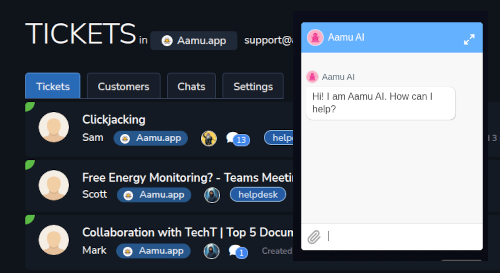
Helpdesk and Livechat in Aamu’s public product example. See the complete support workflow.
What Linear triage is optimized for
Linear describes Triage as a special inbox for issues created by integrations, other teams, or people outside the owning team. Before an issue enters the normal workflow, the team can review and decide what should happen to it.
The core actions are deliberately issue-shaped:
Accept the issue into the team's workflow.
Mark as duplicate and merge it into an existing canonical issue.
Decline the issue and optionally explain why.
Snooze the issue until later or until there is new activity.
Route the issue to another team, status, assignee, label, project, or priority.
Linear also adds several automation layers around that workflow. Triage Rules apply deterministic actions when issues match configured conditions. Triage Intelligence uses AI to suggest properties and relationships, such as team, project, assignee, labels, related issues, and duplicates. Linear Agent automations can perform more flexible instruction-based actions when issues enter triage.
A simple example
Imagine a customer writes:
Can Aamu.app be self-hosted?
In Linear, this might become an issue or an Asks request. The triage workflow might route it to the right team, add a customer label, link it to an existing issue about self-hosting, or assign someone to respond.
In Aamu, the first concern is different. The support team needs a correct customer-facing answer. Self-hosting is not the kind of question AI should improvise from general SaaS assumptions. The answer should come from a maintained policy.
Aamu triage can say: this is a self-hosting availability question, the answer has security and commercial implications, do not make claims unless policy knowledge confirms them, and look for an existing Doc or Helpdesk Knowledge Base source before drafting a reply.
If a policy Doc exists but is not yet part of that Helpdesk project's Helpdesk Knowledge Base sources, Aamu can make that visible. The user can add the Doc to Helpdesk Knowledge Base, reindex it, and then ask AI to draft the reply from the newly available source.
Side-by-side comparison
Area | Aamu.app | Linear |
|---|---|---|
Primary object | Customer message or Helpdesk item | Issue |
Main workflow | Understand a customer request, decide the next action, and prepare a safe response | Review incoming issues before they enter the team's normal workflow |
Best automation fit | Intent, summaries, risk flags, reply drafts, tasks, Docs, Helpdesk Knowledge Base sources, human assignment | Routing, labels, assignees, priority, projects, duplicates, related issues |
Knowledge base | Helpdesk Knowledge Base, Aamu Docs, Helpdesk knowledge sources, and maintained support policies | Existing issues, historical workspace patterns, integrations, and agent context |
Human decision | Approve AI reasoning, assign a human, update knowledge, review drafts, and send replies | Accept, decline, snooze, merge, route, or adjust issue properties |
Strongest product story | Turn customer conversations into better answers and reusable company knowledge | Keep the product backlog organized as intake scales |
Where Linear may be the better fit
Linear is worth evaluating for dedicated product and engineering intake. Its Triage documentation covers issue review and routing, while Triage Intelligence addresses suggested properties and relationships. Linear Agent documentation describes its agent workflows. Compare the controls that matter to your team: duplicates, routing rules, responsibility and which suggestions can be applied automatically.
Where Aamu has a different advantage
Aamu's advantage is that its triage can stay close to the customer conversation and the company knowledge needed to answer it.
A Helpdesk item can lead directly to a reply draft. It can also lead to a task when someone needs to investigate. It can lead to a Doc when the team needs a maintained policy. It can lead to Helpdesk Knowledge Base source updates when the right knowledge exists but is not yet available to AI. It can lead to human assignment when the situation is sensitive.
This is also why Aamu's human-in-the-loop model matters. Aamu can draft a reply, but sending the reply is a separate explicit action. AI can create or find a Doc, but the team decides whether that Doc should become a Helpdesk knowledge source. AI can suggest assignment, but the user can choose who should own the ticket.
How a ticket improves maintained support knowledge
The most important Aamu idea is the knowledge loop:
A customer asks a question.
AI triage identifies the intent and risk.
Helpdesk Knowledge Base retrieves what the company already knows.
If the knowledge is missing, AI can suggest a Doc or task.
If the knowledge exists but is not connected, the user can add it to Helpdesk Knowledge Base sources.
The user can reindex Helpdesk Knowledge Base and ask AI to draft again.
A human reviews and sends the final reply.
The improved knowledge helps future tickets.
Before you switch
Does Linear require Business for all triage?
Core Triage and Triage Intelligence are different capabilities. The current plan matrix lists Triage Intelligence with Business. Check the controls and integrations you need rather than treating the Business AI price as the entry price for all issue intake.
Can Aamu replace our engineering backlog as well?
Test issue relationships, duplicate handling, cycles, routing, reporting and code-tool integrations separately. Aamu’s support triage workflow does not by itself establish parity with your engineering planning setup.
What should a support triage pilot include?
Use a known answer, a missing policy, a duplicate report and a request for a human. Verify retrieved sources, proposed assignments and follow-up Tasks, then review the final customer reply before sending.
Test intake with four real requests
Choose Linear when engineering issue intake is the central job. Try Aamu for a support queue where triage needs to produce a grounded customer answer and maintained company knowledge. Create an Aamu workspace and run that pilot with the people who will use it.
Related articles
- AI support in Aamu.app
- From Helpdesk ticket to Helpdesk Knowledge Base: AI triage, Docs, and human review in Aamu.app
- AI customer support with Aamu.app: Helpdesk Knowledge Base, drafts, and human review
- How Aamu.app uses the Helpdesk Knowledge Base for grounded support answers
- How to build a support knowledge base that AI can actually use